
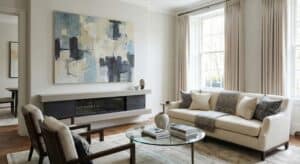
Transitional interiors have become a sought-after style in both residential and commercial spaces for their balance of classic sophistication and modern simplicity. This approach brings together the warmth and timelessness of traditional design with the clean lines and minimalism of contemporary aesthetics. However, achieving true harmony in transitional spaces requires more than just furniture and finishes—it hinges on the final layer: art.
In transitional design, artwork plays a critical role in tying elements together, offering a refined yet expressive touch that completes the aesthetic narrative.
Bridging Traditional and Modern
At the heart of transitional design lies contrast: curved versus straight lines, textured fabrics next to sleek surfaces, and antique details amid modern geometry. Art becomes the glue that binds these contrasts into a cohesive whole. Through thoughtful selection and placement, artwork can subtly echo elements from both ends of the style spectrum.
For instance, a beautiful abstract wall art provides an ideal medium to reflect this duality. Abstract forms naturally embody modern sensibilities, but when rendered in muted or neutral tones, they can evoke a sense of classic restraint. This dual function ensures they neither dominate the space nor fade into the background, but rather enhance the layered feel that defines transitional interiors.
Adding Emotional Depth and Personality
While transitional design emphasises balance and symmetry, it can occasionally risk feeling impersonal or staged. This is where art steps in—not only as decoration but as a medium for personal expression.
Art allows designers and homeowners to inject individuality into a curated space. A bold canvas or a contemplative black-and-white print can introduce a sense of drama or calm, depending on the desired atmosphere. By layering in works that resonate emotionally, even the most tailored rooms gain warmth and depth. This emotional connection is crucial in spaces that aim to be both functional and inviting.
Complementing a Neutral Palette
Transitional design often favours a subdued colour scheme—think greys, taupes, creams, and charcoals. While this offers versatility and sophistication, it can also lean towards monotony without the right visual accents.
Art can punctuate these muted tones with bursts of colour, pattern, or layered composition. Even within the same colour family, art can add variation through shadow, light, and depth. For example, a piece with cool blue undertones might complement a grey sofa while introducing visual nuance.
Notably, abstract pieces are particularly effective here as they often explore tone and composition rather than literal imagery, offering visual intrigue without disrupting the overall harmony of the room.
Enhancing Spatial Flow and Visual Interest
One of the challenges in transitional interiors is maintaining a sense of movement and flow between different zones, especially in open-plan layouts. Strategic art placement can guide the eye and help delineate spaces without the need for walls or screens.
Larger-scale pieces can anchor feature walls or unify living and dining areas. Conversely, a series of smaller works, such as a gallery wall, can lend rhythm to a hallway or transitional corridor. In doing so, artwork becomes a spatial tool, balancing form with function.
Moreover, textures and finishes in art, such as impasto painting techniques, metallic leaf, or mixed media, can provide tactile contrast to polished surfaces, soft textiles, or wood elements often found in transitional interiors.
Supporting a Curated, Timeless Look
One of the defining traits of transitional interiors is their timelessness. By avoiding trends and focusing on enduring appeal, this style ensures longevity. Investing in quality artwork, whether from emerging artists, vintage collections, or bespoke commissions, elevates the design and enhances the perception of the space.
Avoiding mass-produced or overtly trendy pieces helps maintain the design’s integrity over time. The aim is not just decoration but curation: each piece should feel intentional, adding to the story of the space.
The Final Brushstroke in Transitional Design
Transitional interiors embody balance, subtlety, and timeless appeal. While architectural elements and furnishings lay the foundation, it is art that completes the picture—literally and figuratively. It provides cohesion between old and new, injects soul into structured spaces, and enhances the flow and function of any interior.
By selecting artwork with care and intent, designers and homeowners alike can transform transitional spaces from simply stylish to truly sublime.