
Table of Contents
- How Orthodontic Care Changes With Age
- Why an Early Evaluation Can Help
- Common Concerns in Children
- Treatment Choices for Teens
- Orthodontic Options for Adults
- Braces or Clear Aligners?
- When Bite Correction Matters
- What Affects Treatment Time?
- Daily Care During Treatment
- Why Retainers Matter
- Questions to Ask Before Starting
Orthodontic treatment is not only about creating a straighter-looking smile. It can also address how teeth fit together, how the jaws develop, and how comfortably a person bites and chews. Whether a patient is seven, seventeen, or seventy, the right plan depends on their oral health, bite pattern, growth stage, and daily routine.
Families and adults exploring treatment can benefit from speaking with an Orthodontist Wichita patients can consult for an individual assessment. A professional evaluation helps identify which concerns need treatment now, which should be monitored, and which appliance may be the most practical fit.
How Orthodontic Care Changes With Age
Age matters in orthodontics, but it is only one part of the picture. Children may still be growing, which can create an opportunity to guide jaw development or make room for incoming permanent teeth. Teens often have most or all permanent teeth in place and may be ready for comprehensive treatment. Adults can also move healthy teeth, although their treatment plan may need to account for previous dental work, gum health, or bite changes that developed over time.
An early screening does not mean every child needs braces immediately. In many cases, the most useful plan is periodic observation. Watching eruption patterns, jaw growth, and tooth spacing can help an orthodontist recommend treatment at a time when it is likely to be most effective.
Why an Early Orthodontic Evaluation Can Help
The American Association of Orthodontists recommends an orthodontic checkup by age seven, or sooner when a parent or dentist notices a concern. At this age, a clinician can often evaluate developing crossbites, crowding, narrow arches, open bites, and teeth that may be blocked from erupting normally. Learn more about early orthodontic treatment and why timing can matter.
Early care, sometimes called interceptive treatment, has a focused goal. It may help correct a developing bite issue, guide jaw growth, preserve space, or reduce the impact of an oral habit. It does not always eliminate the need for later braces, but it can make later treatment simpler in selected cases.
Common Concerns in Children
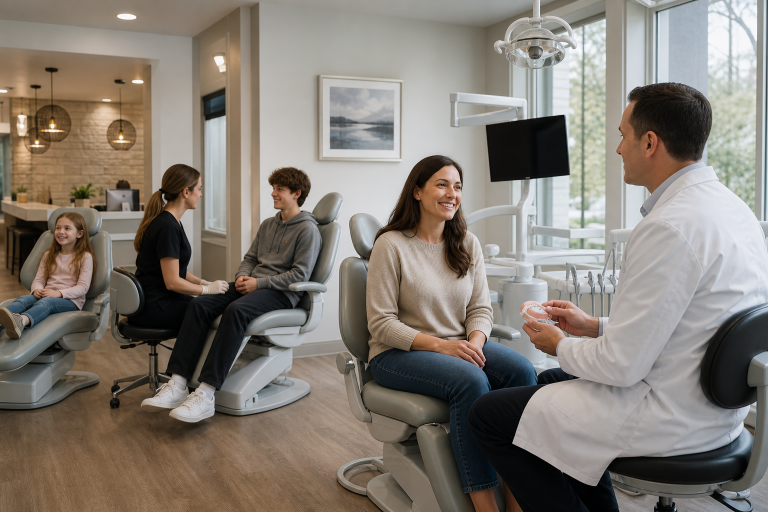
Parents may notice crowded teeth, a jaw that shifts when the child bites, teeth that seem trapped behind others, or difficulty chewing. Thumb or finger habits, tongue posture, and persistent mouth breathing may also deserve discussion with a dental professional. Crossbites and significant crowding are particularly worthwhile to evaluate because they can affect how teeth and jaws develop.
A Simple Parent Checklist
- Watch for trouble biting, chewing, or closing the teeth comfortably.
- Notice teeth that appear crowded, misplaced, or unable to erupt.
- Pay attention to unusual jaw movement, mouth breathing, or prolonged sucking habits.
- Ask a dental professional whether an orthodontic screening would be helpful.
Treatment Choices for Teens
Teenagers often choose among metal braces, ceramic braces, and clear aligners. Metal braces are durable and effective for many tooth and bite movements. Ceramic braces can be less noticeable, while aligners are removable and may appeal to teens who want a more discreet option. The best choice depends on the movements needed, not appearance alone.
Cooperation has a real effect on progress. Teens need to brush carefully, attend visits, wear elastics when prescribed, and keep aligners in for the recommended time. Athletes should use an orthodontic mouthguard for contact sports. Musicians may need a brief adjustment period, especially with wind instruments, but most adapt with practice.
Orthodontic Options for Adults
Adults commonly seek orthodontic care for crowding, shifting after earlier treatment, bite discomfort, or a desire for a more balanced smile. Healthy teeth can often be moved at many ages. Before starting, an orthodontist may coordinate with a general dentist or other specialist if there are concerns involving gums, restorations, missing teeth, or jaw function.
Work schedules, travel, weddings, and other milestones can all factor into appliance selection and timing. Fixed braces may offer predictable control in complex cases. Removable aligners can be convenient for meals and brushing, but only when they are worn consistently.
Braces or Clear Aligners?
There is no universal “best” appliance. A useful comparison starts with the treatment goal and then considers lifestyle, hygiene habits, and reliability with daily instructions.
- Metal braces: Fixed to the teeth, visible, and well-suited to many routine and complex movements.
- Ceramic braces: Less noticeable than metal brackets, though they still require careful cleaning and appliance care.
- Clear aligners: Removable and generally subtle, but they must be worn as directed and stored safely whenever removed.
Clear aligners use a series of custom trays to move teeth gradually. They can treat many concerns, but they are not appropriate for every case. Some movements are more predictable with braces, and some patients benefit from a combination of approaches.
When Bite Correction Matters
Orthodontics can address more than crooked teeth. An overbite occurs when the upper front teeth overlap the lower teeth too much. An underbite places the lower teeth ahead of the upper teeth. A crossbite involves upper teeth biting inside lower teeth, while an open bite leaves a gap when the back teeth are together. Depending on the situation, bite concerns may contribute to uneven tooth wear, chewing difficulty, or discomfort.
Severe jaw-related differences may require coordinated care involving orthodontics and oral surgery. A personal examination is the only way to determine whether that level of treatment is necessary.
What Affects Treatment Time?
Treatment length varies widely. Important factors include case complexity, growth patterns, appliance type, appointment attendance, oral hygiene, and whether aligners or elastics are worn as directed. Unexpected changes, such as broken appliances or delayed tooth eruption, can also affect the schedule. Online timelines are general estimates, not personalized predictions.
Daily Care During Treatment
- Brush thoroughly around brackets, wires, attachments, and the gumline.
- Clean removable aligners according to the orthodontist’s instructions.
- Limit hard, sticky, and highly sugary foods that can damage appliances or increase cavity risk.
- Wear a mouthguard during contact sports.
- Contact the orthodontic office if a wire, bracket, retainer, or aligner causes persistent problems.
Why Retainers Matter
Teeth can shift after active treatment because the surrounding tissues continue adapting over time. Retainers help preserve the new tooth positions. Some are removable, while others are bonded behind the teeth. Store removable retainers in a protective case, clean them regularly, and follow the prescribed wear schedule. Retention is not an optional afterthought. It is part of maintaining the result.
Questions to Ask Before Starting
- What specific problem is treatment designed to correct?
- Which options fit the patient’s age, habits, and goals?
- How often are appointments usually needed?
- What daily cleaning and food restrictions will apply?
- What happens if an appliance breaks or aligners are lost?
- What is the expected treatment range, and what could affect it?
- What type of retainer will be needed afterward?
- Which costs may fall outside the initial estimate?
A Practical Path Forward
Orthodontic care can support children, teens, and adults at different stages of life. The strongest plan is one built around the patient’s bite, oral health, growth, routine, and goals. A thoughtful evaluation can help patients compare choices clearly, avoid unnecessary urgency, and take the next step with confidence.