
Key Takeaways
- Utilize recycled materials to enhance sustainability and cost-effectiveness while reducing reliance on new raw resources.
- Adopt permeable paving solutions to enhance stormwater management, minimize runoff, and promote local ecosystem health.
- Implement warm-mix asphalt technologies to lower emissions and energy consumption during production and construction.
- Incorporate bio-based binders to decrease reliance on petroleum products, supporting cleaner and more renewable material cycles.
- Employ innovative technologies for real-time, proactive maintenance and advanced monitoring of pavement conditions.
Table of Contents
- Incorporating Recycled Materials
- Permeable Paving Solutions
- Warm-Mix Asphalt Technologies
- Bio-Based Binders
- Smart Technologies for Maintenance
- Conclusion
Effective asphalt maintenance is crucial for infrastructure, supporting roads and paved surfaces while addressing climate change and resource scarcity. There is an increasing focus on sustainable practices that extend pavement life, minimize environmental impacts, and responsibly utilize resources. Innovative approaches such as material recycling and new technologies are yielding advantages, including lower repair costs, improved community reputation, and reduced carbon footprints, which align with broader sustainability objectives. For property owners and project managers seeking commercial pavers St Louis MO, sustainability has rapidly evolved from a desirable bonus to a central criterion when planning and executing pavement maintenance projects.
Sustainable pavement management involves strategic, long-term investments that enhance the safety and durability of roadways while complying with regulatory standards. Utilizing modern materials and technologies allows for resource conservation in building resilient infrastructure. Continuous improvements in maintenance processes, including the selection of eco-friendly materials and advanced monitoring, help establish new benchmarks in responsible pavement management. As awareness grows, sustainable practices are being incorporated into all aspects of road design, construction, and maintenance, prioritizing the protection of future generations.
Incorporating Recycled Materials
The use of recycled asphalt pavement (RAP) has become a best practice in creating truly sustainable infrastructure. By reclaiming up to 95% of existing materials during repairs and resurfacing, modern milling and blending equipment enable the reincorporation of once-waste materials into new mixes. This reduces the need for new aggregates and crude oil-derived bitumen, thereby preserving scarce natural resources for future use and minimizing the environmental footprint associated with extraction and transportation. Maintenance methods, such as full-depth reclamation and hot recycling, have proven track records for significantly reducing both the costs and carbon impacts of pavement projects. According to the U.S. Environmental Protection Agency, asphalt recycling alone saves approximately 60 million cubic yards of landfill space each year. It reduces raw material use by up to 40% in various applications. Increasingly, local governments and private contractors are setting mandatory minimum RAP contents in their projects. This trend is not only pushing the market toward sustainability but also driving innovations in blending, mixing, and quality control that yield even more durable paved surfaces. To learn more, visit the EPA’s Sustainable Management of Construction and Demolition Materials.
Permeable Paving Solutions
Managing stormwater and mitigating surface runoff has propelled the widespread adoption of permeable paving solutions, especially in densely populated and urbanized regions. Porous asphalt and other permeable paver designs enable rainwater to filter through the pavement itself, moving into base layers or being directed toward underground reservoirs rather than simply flowing off into overloaded storm drains. This approach helps to prevent both minor and severe surface flooding and avoids placing excess stress on municipal drainage systems, many of which are aging or undersized. Incorporating permeable pavement into stormwater management plans is now a recommended sustainable asphalt maintenance strategy, often implemented in conjunction with traditional drainage solutions to maximize effectiveness. Beyond improved water management and public safety, permeable pavers also offer environmental benefits by supporting local groundwater recharge, reducing heat island effects, and minimizing soil erosion. Because these surfaces can be specified for walkways, driveways, commercial lots, and even some roadways, they offer flexibility and adaptability for green infrastructure projects. For a closer look at how these innovations are being deployed, see resources from the American Society of Civil Engineers.
Warm-Mix Asphalt Technologies
Warm-mix asphalt (WMA) technologies represent a significant leap forward in reducing the energy demands and emissions associated with asphalt production and paving. Unlike traditional hot-mix asphalt, which requires adhesion and application at high temperatures, WMA techniques introduce additives or modify production processes to allow blends to be mixed and laid at much lower temperatures. These reductions in heat requirements result in substantial energy savings, which directly translate into less fuel consumption and lower greenhouse gas emissions at both batch plants and job sites. Additionally, lower-temperature application improves working conditions for paving crews, as fewer hazardous fumes are emitted and the risk of heat-related injuries is reduced. WMA has been shown to provide excellent compaction even at reduced temperatures, leading to durable, longer-lasting pavements. Today, an increasing number of transportation agencies and private companies are adopting warm-mix as their default approach for sustainable road maintenance and repairs. According to the National Asphalt Pavement Association, many regions are already experiencing improved pavement quality and lower environmental impacts thanks to this growing technology.
Bio-Based Binders
The rapid movement toward bio-based binders in asphalt mixtures is driven by efforts to transition away from petroleum-derived components and shift innovatively toward cleaner, renewable resources. Unlike conventional asphalt binders made from crude oil, bio-based versions are created from renewable feedstocks such as algae, lignin (a byproduct of paper manufacturing), or crop byproducts. These innovative binders not only reduce dependence on finite fossil fuels but also provide unique material advantages, including improved flexibility, superior resistance to moisture and UV damage, and even self-healing capabilities that can close microcracks as they form. Research projects are increasingly demonstrating that roads built with algae-based binders can last longer and maintain their structural integrity under heavy loads and temperature fluctuations, all while exhibiting a substantially lower lifecycle carbon footprint. For municipalities seeking to invest in resilient and eco-conscious infrastructure, the adoption of bio-based binder technology promises both low-impact construction and long-term sustainability for essential transportation networks and public spaces.
Smart Technologies for Maintenance
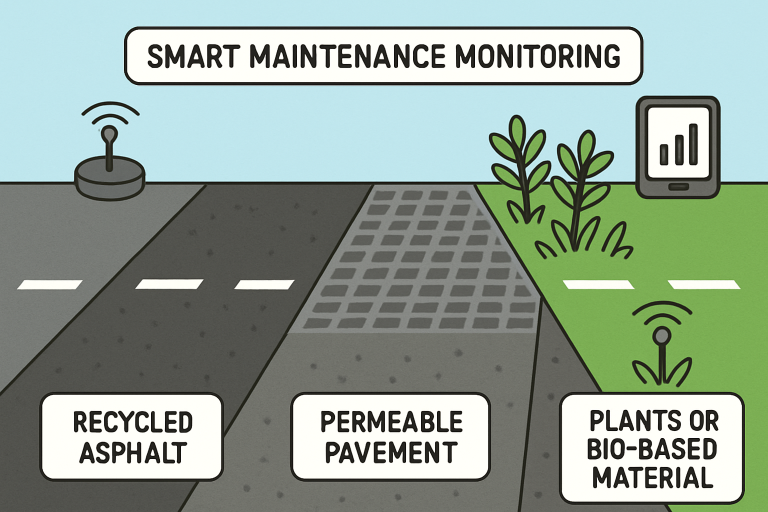
Digital transformation is fundamentally reshaping the way roads and pavement infrastructure are monitored, maintained, and repaired. By deploying a range of sensors and leveraging digital twin technologies, pavement managers and engineers can assess pavement health in real-time, identifying wear patterns and damage before they become costly and disruptive problems. This predictive capability means maintenance can be proactive rather than reactive, resulting in timely repairs that extend pavement life and minimize disruptions. As more agencies pair these sensor networks with advances in machine learning and artificial intelligence, the resulting data-driven insights can help optimize everything from traffic flow allocation to maintenance crew deployment. Recent studies suggest that a unified Digital Twin and Graph Neural Network framework can significantly enhance forecasting accuracy for pavement deterioration, providing a closed feedback loop that facilitates continuous improvement throughout the full lifecycle of an asphalt asset. These smart systems enable infrastructure owners to minimize overall expenses while achieving more reliable, resilient, and environmentally friendly road networks.
Conclusion
Integrating sustainable asphalt maintenance best practices is now a necessity for municipal agencies, commercial property owners, and project managers committed to infrastructure resilience, public safety, and environmental responsibility. By maximizing the use of recycled materials, implementing permeable paving, leveraging warm-mix technologies, exploring bio-based binders, and embracing smart maintenance tools, both cities and businesses can ensure their investments deliver value over the long term. In the process, they also play a crucial role in mitigating harmful impacts, enhancing community well-being, and supporting the broader movement toward sustainability. Across the country, these strategies are quickly becoming the benchmark for quality, durability, and responsible stewardship in modern pavement management.